Course introduction
Welcome to Functional Programming with OCaml. This first lecture is short and almost entirely logistical: what we will cover over the twelve weeks, who the course is aimed at, how it is graded, and how you will run OCaml code directly in your browser without installing anything. The next lecture is where the actual technical content begins.
I want to spend this opening session on framing rather than on syntax, because the choices a course makes about what to teach are themselves worth understanding. There are dozens of programming language courses on NPTEL and elsewhere, and they make very different choices about which language to use, which features to emphasise, and how much mathematical content to include. By the end of this lecture you should know what kind of course this is, and whether it is the right one for what you want to learn next.
A quick note on the format. Every lecture in this course comes as both a 20-30 minute recorded video, where I work through slides with you, and a long-form chapter, which is what you are reading now. The chapter elaborates on the same material, with more worked examples, asides, pitfalls, and inline quizzes you can attempt. The slides are the spine; the chapter is the body. If you only have time for one, watch the video. If you want to really learn the material, read the chapter afterwards.
Who is this course for?
This is a course about programming languages, taught through one
particular language. The audience I have in mind is a third- or
fourth-year undergraduate in computer science who has written some
C, maybe some Java or Python, knows what a pointer is, knows what
a for loop is, and has taken a data structures and algorithms
course. If that's you, you have everything you need.
It is also a course for working software engineers who want to broaden the set of language paradigms they are comfortable in. Functional programming concepts have crossed over into mainstream languages over the last decade: lambdas in C++ and Java, type inference in Rust and TypeScript, pattern matching in Swift and Python (since 3.10), immutable data structures everywhere. Working in OCaml for twelve weeks gives you a coherent setting where all of these ideas hang together, instead of feeling like bolt-ons to a language designed for something else.
It is not a first programming course. We will not pause to explain what a variable is or what a function call does. If those concepts are still wobbly for you, work through any introductory programming text first, then come back. The functional-programming half makes occasional cross-language asides (Python, Java, C, Rust, and the odd JavaScript) where they help orient the reader. The secure-systems half (Modules 9 to 12) leans on C and C++ heavily as the canonical "what unsafe languages do" baseline, so by then you will want to be able to read C syntax casually.
What you will learn
The course splits cleanly into two halves. The first eight modules (weeks) teach functional programming proper, using OCaml as the vehicle. We start with expressions and values, work up through functions, data types, pattern matching, higher-order functions, side effects, modules, and finally monadic abstractions and generalised algebraic data types. By the end of Module 8 you will be able to read and write idiomatic OCaml at the level of a working professional, and you will have internalised the FP habits of thought that transfer to every other language you will ever use.
The last four modules (weeks 9-12) cover secure systems software, which sounds like a separate course but is intimately connected to what we did in the first half. Module 9 takes the type-safety intuition you built up over the first eight weeks and asks the sharper question: what kind of bug does the type system structurally fail to catch? The answer is "behaviour", and the response is testing. We cover OUnit2 for unit tests and QCheck for property-based testing, which is a particularly natural fit for a language where so many functions are pure. Module 10 then turns to memory safety as a security story. The reason we can talk about "undefined behaviour" precisely in week 10 is that we will have spent eight weeks pinning down what defined behaviour even means; week 10 names the C memory bugs (use-after-free, buffer overflow, uninitialised read, double-free) and shows how they become CVEs. The industry numbers are stark: roughly 70% of the vulnerabilities Microsoft fixes each year are memory-safety bugs (MSRC, 2019); the Chromium project found about the same 70% share among its high-severity bugs (2020); 76% of Android's vulnerabilities in 2019 were memory-safety bugs in its native (C/C++) code (Google, Memory Safe Languages in Android 13, 2022); and Google's Project Zero found that roughly two-thirds of the 0-days exploited in the wild in 2021 were memory-corruption bugs. The White House February 2024 memorandum urged the industry toward memory-safe languages. Week 10 then shows how OCaml rules each of these bug classes out by construction. We also walk a Heartbleed-style example end to end. Module 11 picks up where the vanilla type system stops: OxCaml, a research branch of OCaml maintained by Jane Street, adds a mode system on top of the language we will have learned by then; the modes extend the types with locality (safe stack allocation), uniqueness (use-after-free of manually managed resources, caught at compile time), and linearity (use exactly once). Module 12 caps the course by asking what falls out if a language is this safe: the answer is MirageOS, where the operating system itself is an OCaml program.
The course map
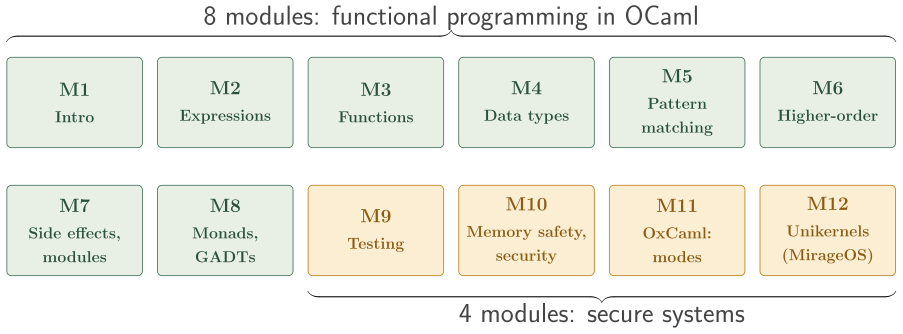
Eight FP modules, then four secure-systems modules.
Three skills you will leave with, in increasing order of generality:
You will write idiomatic OCaml. Not just OCaml that compiles, but
OCaml that an experienced reviewer would glance at and nod.
Idiomatic means the natural way to express an idea in this
language: when to reach for a record instead of a tuple, when a
variant beats a class hierarchy, when pattern matching is clearer
than if, when a fold is clearer than a loop. Each of these choices
feels arbitrary at first and obvious in retrospect; the course is
largely about getting you to the second state.
You will reason equationally about your code. This is shorthand for a habit of mind that functional programming makes possible. When a function is pure (returns a value, has no side effects), you can substitute equals for equals: replace any expression with its value, replace any call with its body. This sounds like a small thing and is in fact one of the larger differences between FP and imperative programming. We will spend the next lecture setting up why this matters, and the rest of the course exercising it.
You will understand the safety story. OCaml is one of a small
number of mainstream languages where memory safety is provided by
construction in the type system while staying within a small
constant factor of C and C++ in performance. Idiomatic OCaml is
often very close to C on tight code, sits in the same league as
Java or Go on typical workloads, and is dramatically faster than
dynamic languages like Python or Ruby. The safety is not paid for
with slowness: it comes from the type system ruling out, at
compile time, classes of undefined behaviour that C programs hit
at runtime. Garbage collection (the runtime feature that
reclaims memory automatically once a value is no longer reachable,
so you never call free by hand) helps on top, but the load-bearing
safety is in the types. The secure-systems half of the course makes
this concrete on three fronts. Where types reach their structural
limit (a well-typed function can still compute the wrong answer),
Module 9 brings in tests, both
unit tests and property-based tests, as the complement that catches
behaviour. Where vanilla OCaml's types reach their limit (stack
allocation, manually managed resources), Module
11 introduces OxCaml's mode system,
which extends the types to track how a value may be used, not just
what it is. In between, Module
10 makes the memory-safety claim
precise: you will see what defined and undefined behaviour mean,
the C bug classes the GC plus types rule out, and where the OCaml
runtime itself draws the line.
Why OCaml?
The choice of OCaml deserves some defense, because it is not the most popular language and you might reasonably ask why we did not pick Python or Rust or Haskell. The short answer is that OCaml is the best teaching language for the concepts we want to teach. The long answer comes in three parts.
First, OCaml is functional-first with a serious type system.
"Functional-first" means immutability, expressions, recursion,
and higher-order functions are the natural way to write programs,
the same way classes and inheritance are natural in Java. "Serious"
means the type system is sound: if your program type-checks,
certain classes of bugs simply cannot happen. Sound, expressive
type systems are uncommon. JavaScript and Python have no real
static types. C++ has a type system that lets you escape too
easily, via reinterpret_cast, void*, and pointer arithmetic.
Java's type system is sound, but its vocabulary forces you to
express optionality through nullable references and tagged unions
through class hierarchies, which means a lot of "did you remember
to handle this case?" lives at runtime instead of compile time.
Rust is the closest sibling to OCaml in this respect, and a lot
of Rust's design is directly inherited from ML (the family OCaml
belongs to). The name records that lineage: "OCaml" is Objective
Caml, and "Caml" was the Categorical Abstract Machine Language,
built at the French research institute INRIA in the 1980s on top
of Robin Milner's ML. The "Objective" arrived in 1996 with an
object system the course never uses; the functional core under
the name is the part that matters.
Second, OCaml is practical. It is used in production at Jane Street (whose internal systems are millions of lines of OCaml), Bloomberg (financial infrastructure), Facebook (the Hack and Flow type checkers for PHP and JavaScript respectively, both written in OCaml), Docker (their virtualization toolkit), Ahrefs (one of the world's largest web crawlers and SEO platforms, with a backend in OCaml), Semgrep (a static-analysis tool for finding bugs and security issues, written in OCaml), and Tarides (the OCaml platform company, builder of MirageOS and the Multicore OCaml runtime). It powers the WebAssembly reference interpreter that defines the WebAssembly standard, and the CompCert verified C compiler. Rust's first compiler was written in OCaml. So is the Rocq theorem prover (formerly Coq), and the Tezos blockchain. Beyond industry, OCaml is widely used across academia. "Practical" here means: people use it to ship things that other people depend on. This is not a research curiosity.
Third, OCaml is fast. The native-code compiler produces binaries that run within a small constant factor of C for most workloads. The garbage collector is incremental and concurrent in recent versions. There is no virtual machine, no JIT warmup, no interpretation overhead. When you write a tight loop in OCaml and compile it to native code, you get something close to what you would get from a C compiler. Functional programming has picked up a reputation in some circles for being slow, often by association with interpreted languages that happen to support functional idioms; OCaml is the counterexample.
A fourth reason worth listing separately: OCaml is small. The core language fits in a long afternoon: a handful of expression forms, a handful of type constructors, a module system, a few sugar constructs. Larger industrial languages (C++ is the classic example, but Scala and modern Java are not far behind) accumulate so many features over time that the surface area for surprise grows with them. OCaml's smallness lets us spend lecture time on why things are the way they are, rather than on enumerating syntax.
You will also be re-using almost everything you learn here in other
languages. Type inference, sum types (also called variants or
algebraic data types or "enums" in Rust and Swift), pattern matching,
higher-order functions, generics with parametric polymorphism, the
Option type as a replacement for null, immutability by default,
the Result type for error handling: every one of these has crossed
over into the mainstream of language design. OCaml is the language
where you can see them in their natural habitat, where they were
designed together as a coherent set rather than added later as
features.
The course book
There is no separate textbook to buy or download. Every lecture in this course is also a page on the course website at https://fplaunchpad.org/ocaml_nptel, and the slides you see in the videos are excerpts from those pages. The website is the book: the same material, expanded into prose, with the examples runnable in place and the quizzes interactive. Open it in any browser; no login, no install, nothing to download.
Run code right in this page
Before we get to the syllabus and grading, let me show you how the course infrastructure works, because it shapes what you can do with the lecture pages.
Every lecture has runnable OCaml cells embedded in it. Like this:
If you are reading this in a browser, you should see a "Run" button near the top right of the code block above. Click it. The OCaml toplevel runs in your browser (no server, no install, the bytes never leave your machine) and the output appears below the cell. The first run takes a few seconds while the OCaml runtime loads into your browser; subsequent runs are fast.
The toplevel embedded in these pages is OCaml 5.4.0, the
current stable release at the time of writing. If you decide to
install OCaml locally and follow along on the command line, use
opam (the OCaml package manager) to
create a 5.4.0 switch; everything in the lectures is checked
against that version.
You can edit the code. Try changing "NPTEL" to your own name and
clicking Run again. If you make a syntax mistake, you will see the
compiler error inline; fix it and run again.
The little ↺ button next to Run resets the cell back to its original source if you have edited it. Your edits are saved in your browser's local storage, so if you close the tab and come back, your code is still there. This is meant to be a notebook, not a one-shot demo.
A useful feature you might not discover by yourself: hover the
mouse over an expression in any cell and the editor shows its
inferred type as a tooltip. This is the same information the
toplevel prints as val name : type = value after a Run, but you
get it inline without running anything. When you are reading
unfamiliar code, the hover is the fastest way to find out what a
particular sub-expression has type.
A full machine for the second half
The cells you have just seen are the light tier of the course infrastructure: an OCaml toplevel compiled to JavaScript, perfect for trying out an expression or a small definition without leaving the page. The functional-programming half of the course lives almost entirely in cells like these.
The secure-systems half needs more than a toplevel. To run a test
suite, measure coverage, compile and run a C program, or build and
boot an operating system, you need a real project on a real machine:
dune, several source files, a test runner, a C compiler. So the
later lectures embed a full Linux machine that also boots inside
your browser tab. The promise is the same as the cells: nothing is
installed on your computer and nothing runs on a server; the entire
machine runs in the page. It is heavier than a cell (it boots on a
click and takes a few seconds to come up), so we bring it out only
where a real build matters: Module
9 runs test suites and coverage reports,
Module 10 compiles and
runs the C programs whose memory bugs we study, and Module
12 builds and boots a MirageOS unikernel.
Here is one now, as a taste of what is coming. Click to boot it; you
land in a small dune project called hello. Run dune exec ./hello.exe to build and run it, edit hello.ml with nano, and
run it again.
Anonymous quiz analytics
A small operational note. The site records anonymous responses to the inline quizzes, so I can see which questions are hardest and revise the surrounding material. No personal data is collected; no account exists; no IP address is retained. A random reader identifier is stored in your browser to associate your answers with each other (so I can tell two responses came from the same reader) and that identifier is the only thing tying responses together. The methodology mirrors the Brown PLT TRPL quiz study that motivated the inline-quiz design.
If you would prefer to opt out, the Privacy page has a one-click toggle and a "delete my data" button that scrubs every response associated with your browser. The toggle is per-device, so turning it off on your laptop does not affect your phone. Opting out has no effect on grading or on your ability to use the cells and quizzes locally.
Below the cell, look for inline quizzes (which I will show you in later lectures). They come in two flavours: multiple-choice questions with explanations, and code-completion challenges where you fill in a function and click Check to run a set of tests against your solution. Both are optional but recommended; they're the difference between thinking you understood a chapter and actually understanding it.
A taste of OCaml
Here is something you will be able to write yourself by Week 6. Don't worry about understanding the syntax now. Just click Run and look at what comes out.
The output is a list of integers, in OCaml notation: [2; 3; 5; 7; 11; 13; 17; 19; 23; 29; 31; 37; 41; 43; 47]. Those are the primes
up to 50, computed by a version of the
Sieve of Eratosthenes
that fits in five lines. Without explaining anything yet, notice
a few things.
There is no loop in this code. There is no mutable counter, no
++, no array index. The function sieve is recursive: it calls
itself on a smaller input. The function range does the same. This
is how you express iteration in OCaml.
The line | p :: rest -> ... is pattern matching:
it says "if the input list has a first element p followed by some
rest, do the following." If you have written switch in C or Java,
pattern matching is like that but on the structure of values, not
just on their tags.
The expression fun n -> n mod p <> 0 is an anonymous function: a
function with no name, defined inline. We pass it as an argument to
List.filter. Passing functions around like
this is normal in OCaml and central to what makes the language
compact. We will spend Module 6
on this idea alone.
The point of showing you this in lecture one is not to teach the
syntax. It's to set the bar: in twelve weeks, you will look at this
five-line program and read it as easily as you would read a for
loop today. That is the destination. The route there is the rest of
the course.
How the course is graded
NPTEL courses follow a standard grading structure that I do not get to change. The split is 25% weekly assignments, 75% final certification exam, with a 40% overall threshold to receive a certificate.
A few details worth knowing. Assignments are released on the same weekly cadence as the videos and are submitted through the SWAYAM portal. Submission deadlines are strict: the portal closes at the deadline. NPTEL does not allow late submissions and I cannot make exceptions. The exact format of each assignment (how much OCaml you write, how much is multiple-choice, how it is auto-graded) is finalised closer to release; treat the assignment page as the authoritative source for that week.
The final exam is conducted in person by NPTEL at their proctored exam centres across India. NPTEL sets the exam format; details will be confirmed on the SWAYAM platform before the exam window. Whatever the format, the questions will test real understanding of the course material rather than memorised syntax.
The 40% threshold for a certificate is the standard NPTEL pass mark. Most students who follow along weekly comfortably clear it. The distribution of marks in past iterations of similar courses has been wide; serious engagement gets you well above 40%.
The structure of each week
Every week of the course follows the same shape, so you can plan your time once and then run on autopilot.
The videos are deliberately short. Past experience with longer lecture videos shows that engagement falls off sharply past 30 minutes, so I have broken each topic into bite-sized pieces. You can watch one a day over the working week and finish the week's content without ever sitting down to a long session. The chapter pages (these documents you are reading) elaborate on each video and are meant as the read-after-watching companion.
The tutorial video at the end of each week is important. It is not a walkthrough of that week's assignment; instead, it works through 2-3 problems that exercise the same ideas, with me deriving the solutions on the fly. If you find an assignment problem hard, the tutorial is the first place to look: the techniques you need will have been demonstrated there.
The discussion forum is your main channel for questions. The teaching assistants and I monitor it through the week. Use it. Asking questions in public also helps the other students who had the same question but were too shy to ask.
What this course is not
There are several large topics that this course does not cover, and a student who came in expecting them would be disappointed.
We will not build a production system from scratch. That is a real software-engineering course, and a worthwhile one, but not this course. The longest piece of code you will write in this course fits on one screen.
We will not survey every feature of OCaml. The language has many corners: objects and classes (rarely used in modern code), ppx syntax extensions (a tooling topic of its own), polymorphic variants (mostly specialised), first-class modules (advanced), GADTs (we touch them briefly), effect handlers (a Multicore OCaml feature we leave for a follow-on course). I have picked the subset that will be most useful to you in the largest number of future situations.
We will not do pure type theory. This is a programming course, not a programming-languages-theory course. I will use type-theoretic language ("polymorphism", "parametricity", "soundness") where it helps explain something, and I will not when it does not. If you do want the theory companion, Pierce's Types and Programming Languages is the standard reference, and Software Foundations (Pierce et al., free online) takes you through the same material mechanised in Rocq (formerly Coq).
A quick checkpoint
Before we move on, a small comprehension check on what we just covered. Use it to see whether the logistics are clear.
The certificate grade for this course is computed as:
- 50% weekly assignments + 50% final exam
- 25% weekly assignments + 75% final exam
- 100% final exam (assignments don't count)
- 75% weekly assignments + 25% final exam
Why this matters: the final exam is the bigger lever, but weekly assignments are still 25% of your grade and a much easier way to bank marks. The students who miss assignments and then try to make it up in the final usually struggle: 75% is high but you have to clear it from a cold start. Doing weekly assignments also teaches the material; the final exam tests that you learned.
How is the course split across the 12 modules?
- 12 modules on functional programming
- 6 modules on FP, 6 on secure systems
- 8 modules on FP, then 4 on secure systems
- 4 modules on FP, then 8 on language theory
Why: Modules 1-8 are functional programming proper (expressions, functions, data types, pattern matching, higher-order functions, side effects, modules, monadic abstractions). Modules 9-12 turn the type-safety story toward secure systems: testing (OUnit2, QCheck) for what types miss, memory safety as a security story, OxCaml's mode system, and MirageOS unikernels. The two halves are connected: the safety claims in weeks 9-12 only make sense once you know what the types in weeks 1-8 actually guarantee.
What does it mean that the OCaml toplevel "runs in your browser" on the lecture pages?
- The page sends your code to a remote server, which runs it and returns the output.
- The OCaml runtime is loaded into the browser; your code runs locally and never leaves your machine.
- You need to install OCaml first; the page just shows the source code.
- Only the instructor can edit and run the cells.
Why: every lecture's Run button starts an OCaml toplevel that has been compiled to JavaScript and loaded into the page. Code you type into a cell executes in your browser tab, so there is no server to talk to, nothing to install, and your edits stay on your device (saved in the browser's local storage). The first run takes a few seconds while the runtime loads; subsequent runs are fast.
What's next
Next video: why functional programming? The case for FP given that you can already write programs in imperative languages. We will start by looking at a one-instruction programming language (yes, really) and noticing what makes it hard to read, then look at how functional programming makes programs easier to read instead.
Reading
- The OCaml language home page: https://ocaml.org/. Install instructions, the language manual, and a tour of the ecosystem live here.
- Cornell CS3110 textbook, Preface and Chapter 1: https://cs3110.github.io/textbook/
- Real World OCaml, Prologue: https://dev.realworldocaml.org/prologue.html
- The NPTEL course page (you're already there).
- John Whitington, OCaml from the Very Beginning (book): a gentler pace, useful as a parallel read if you find this course moving too quickly.
Sources
This lecture's prose, worked examples, and quizzes are original to
this course. Materials referenced during preparation are listed in
the Reading section above; Cornell CS3110 and Real World OCaml
are CC BY-NC-ND-licensed and have not been derivatively reused.
See LICENSES.md
at the repository root for the full source posture.