Data races are undefined behaviour
The first lecture listed four categories of undefined behaviour in C, and we have spent two lectures on the memory and lifetime categories. This short lecture takes the one we have so far only named: the concurrency category, and specifically data races, the bugs that appear when a program runs on more than one core at once.
Almost all the code in this course has been single-threaded: one sequence of steps, one at a time. Real systems are not like that. A web server handles thousands of connections; a build tool compiles many files; a renderer paints many tiles. To use the cores a modern machine has, the program must do several things at the same time, and the moment two of those things touch the same piece of memory, we have to ask what happens.
The answer in C and C++ is stark: a data race is undefined behaviour, with all the consequences the first lecture described. The answer in OCaml is different and much safer, and the difference is exactly the kind of guarantee a later module builds on. This lecture keeps to the essentials: what a race is, precisely; what C says; what OCaml says; and how to fix one. The precision is not pedantry. Every guarantee in this story is a guarantee about programs "without data races," and such a guarantee is only as sharp as the definition of a data race it rests on.
What a data race is
A data race is a precise thing, not just "concurrency went wrong." Two threads race when they make two memory accesses (each a read or a write) such that:
- the accesses target the same location,
- at least one of them is a write, and
- no synchronisation orders one access before the other.
The third condition is the precise version of "at the same time." Nothing in the program (a lock, a join, an atomic operation) decides which access goes first, so on any given run either might. Two reads racing is fine: neither changes anything, so the order does not matter. A read racing with a write, or two writes racing, is the problem: the result depends on who got there first, and nothing in the program decided who that was.
In C, the smallest racy program is two threads, one writing a location, one reading it, with nothing ordering the two accesses:
long x = 0;                 /* condition 1: the same location, x */

void *t1(void *_) { x = 1;      return NULL; }  /* 2: one is a write */
void *t2(void *_) { long r = x; return NULL; }  /* ... one reads     */

/* main starts t1 and t2 together; no lock, no join between
   the accesses: condition 3, nothing orders them */
In C and C++, a data race is undefined behaviour
The C and C++ standards place a data race squarely in the undefined category. A program with a data race has no defined meaning at all, exactly like an out-of-bounds write or a use-after-free. Note the scope of that sentence: it is the whole program that loses its meaning, not just the racy line. A concurrent C program containing a single data race, anywhere, can do anything at all. The optimiser is allowed to assume races do not happen and to transform code on that assumption, and the transformations are not confined to the racy location: a race on one variable can make two reads of a completely unrelated variable disagree, with no concurrent write to that variable anywhere in the program. We will return to this point on the OCaml side, because it is exactly the failure OCaml's memory model rules out.
The most visible everyday symptom is lost updates. Here is a
small C program: two threads each add 1 to the same counter a
million times, with no lock. The arithmetic says the total should
be two million. It is not, and it changes from run to run, because
counter++ is really three steps (read, add one, write back) and
the two threads interleave those steps and overwrite each other.
#include <pthread.h>
#include <stdio.h>

static long counter = 0;          /* shared, unsynchronised */
void *bump(void *_) {
    for (int i = 0; i < 1000000; i++)
        counter++;                /* read + add + write: RACE */
    return NULL;
}

int main(void) {
    pthread_t first, second;
    pthread_create(&first, NULL, bump, NULL);   /* start thread 1 */
    pthread_create(&second, NULL, bump, NULL);  /* start thread 2 */
    pthread_join(first, NULL);                  /* wait for both */
    pthread_join(second, NULL);
    printf("expected 2000000, got %ld\n", counter);
}
The two pthread_create calls are the missing concurrency: both
threads execute bump against the same global counter. The two
pthread_join calls wait until they finish before printing. There is
no lock between the read and write inside counter++, so the accesses
race.
On a multi-core machine the lost updates are plain (the in-browser VM has a single emulated core, so it cannot reproduce them, which is itself a lesson: a race can hide entirely depending on the hardware and the schedule):
$ cc -O0 -o race race.c -lpthread && ./race
expected 2000000, got 1002878
$ ./race
expected 2000000, got 1018160
That is the benign face of the bug. The malign face is that, because the race is UB, the optimiser may do far worse than lose a few updates: it can cache the counter in a register, reorder the writes, or delete code it "proves" is unreachable. As with every other UB, "it printed the right number on my machine" is not evidence that the race is gone.
OCaml 5 runs in parallel: domains
To talk about what OCaml does, we need the one parallelism
primitive this course uses: the domain. A domain is a unit of
parallel execution that runs on its own core. Domain.spawn f
starts a new domain running the function f, and Domain.join
waits for it to finish and collects its result.
That is the whole of the API we need. Two domains running at the same time, each doing its own work, rejoining at the end. We are not building a concurrency library; we just need two things running at once so we can ask what happens when they share memory.
OCaml 5 runs in parallel: domains
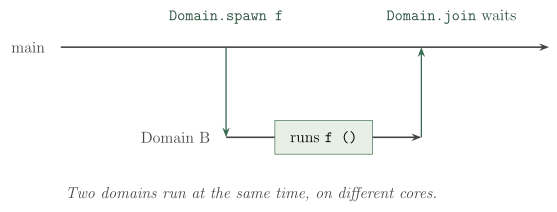
Domain.spawn frunsfon another core.Domain.join dwaits for it and returns its result.- That is all the API we need: two things running at once.
A racy OCaml counter
Now the same shape as the C program, in OCaml: a shared int ref,
two domains each incrementing it a million times, no
synchronisation.
let counter = ref 0
let bump () =
  for _ = 1 to 1_000_000 do
    incr counter
  done
let () =
  let d1 = Domain.spawn bump in
  let d2 = Domain.spawn bump in
  Domain.join d1; Domain.join d2;
  Printf.printf "expected 2000000, got %d\n" !counter
Run on a multi-core machine:
$ ocaml race.ml
expected 2000000, got 1039996
$ ocaml race.ml
expected 2000000, got 992593
The same lost updates as the C version: incr counter is read,
add, write, and the two domains interleave. But notice what did
not happen: the program did not segfault, did not read an
operating-system secret, did not corrupt the heap. It returned a
wrong-but-bounded integer. That difference is the whole point of
this lecture.
OCaml's position: defined, and bounded
OCaml 5's memory model (the manual devotes a chapter to it) starts
from the same definition we gave. The locations are the mutable
ones: ref cells, array elements, mutable record fields. The
synchronisation that orders accesses comes from the operations
built for the purpose: Domain.spawn orders everything before the
spawn ahead of the new domain's first step; Domain.join orders
the joined domain's last step ahead of everything after the join;
locking a Mutex and operations on an Atomic.t cell create order
the same way. Two accesses to the same mutable location, at least
one a write, ordered by none of these: a data race, the same three
conditions as in C. The shared definition is the point. C and OCaml
agree on what a race is; they part company on what a race does.
The first half of OCaml's answer is summarised by the initials DRF-SC. The SC is sequential consistency: a program is sequentially consistent when it behaves exactly as if all the steps of all its domains were interleaved into a single global order. That is the single-threaded intuition you already have, lifted to many cores; it is the behaviour you would want. DRF-SC is then the guarantee that data-race-free programs are sequentially consistent: if your program has no data races, you get that global-order behaviour and need not think about reorderings at all. C and C++ promise this much too. That is the case to aim for, and the synchronisation tools below get you there.
The second half is where the languages part. If your program does
have a race, OCaml still makes a promise that C and C++ refuse to
make: the behaviour is weakly defined but bounded, and the
program stays memory-safe. A racy read of an int returns some
value that was actually written to that location at some point, not
a random bit pattern. A racy read of a boxed value (a record or
array) may observe an earlier or a partially updated state, but
never a wild pointer into unmapped memory. There is no path from an
OCaml data race to a use-after-free or an out-of-bounds read. The
four-bug zoo stays closed even under races.
The promise is in fact sharper than "memory-safe," and sharp enough to have a name: in OCaml, data races are bounded in space and time. Bounded in space: a race on one location cannot affect any other location. Bounded in time: a race cannot reach into the race-free stretches of the run before or after it. Together, every data-race-free part of the program keeps its sequential meaning, even while some other part is racing; the property is called local DRF (local data-race freedom). One concrete consequence: if a domain reads the same ref twice and nothing writes that ref concurrently, the two reads agree, whatever races are raging elsewhere in the program. That is exactly the guarantee we saw the C optimiser break. Java's memory model, for comparison, bounds races in space but not in time. And the stronger promise is cheap: the sequential cost of providing it is zero on x86 and under a percent on ARM.
Bounded in space and time
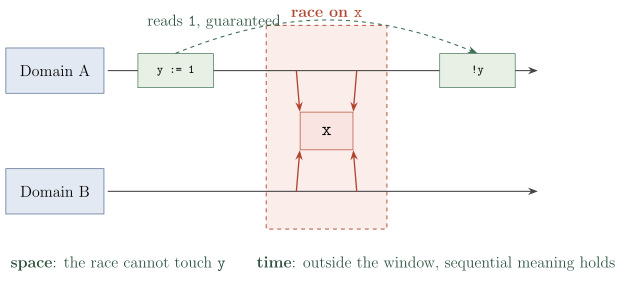
- Every race-free part keeps its sequential meaning ("local DRF").
- Read a ref twice, no concurrent writes: both reads agree.
- in C/C++, a race on an unrelated variable can break this.
The fix: synchronisation
The cure for a data race is the same in every language: knock out the third condition of the definition. Introduce synchronisation that orders one access before the other, and the pair no longer races. OCaml's standard library gives two everyday tools.
For a single shared counter or flag, use Atomic. An Atomic.t
wraps a value so that Atomic.incr, Atomic.get, and friends are
indivisible: no other domain can interleave inside one of them.
Swapping ref/incr for Atomic.make/Atomic.incr removes the
race:
Now each increment is one indivisible operation. Another domain may run before or after it, but cannot slip a read or write into its middle. Running the program therefore prints the same total every time:
$ ocaml atomic.ml
expected 2000000, got 2000000
$ ocaml atomic.ml
expected 2000000, got 2000000
For anything more than a single word (updating two fields together,
a list, a hash table), wrap the shared state in a Mutex: take the
lock, do the update, release the lock, so only one domain is inside
the critical section at a time. Atomic for one cell, Mutex for
compound state, is the whole rule of thumb.
Activity
Which of the following pairs of accesses is a data race?
- Two domains reading the same
int ref, with no writes. - One domain writes a ref while another reads it, with no synchronisation.
- One domain writes a ref, a
Domain.joincompletes, and then another domain reads it. - Two domains write separate refs, so no location is shared.
Why: a data race needs the same location, no synchronisation,
and at least one write. Two reads do not race (neither changes
anything). Separate locations do not race. A write followed by
Domain.join and then a read is synchronised: the join
orders the write before the read. The only racing pair is the
unsynchronised write-and-read of the same location.
A program has a data race on a shared int ref. How do C and
OCaml differ in what can happen?
- Both are undefined behaviour; there is no difference.
- C has undefined behaviour; OCaml keeps the race memory-safe.
- In OCaml the program fails to compile because the race is detected statically.
- In C the value is always the last one written; in OCaml it is always zero.
Why: C and C++ classify any data race as undefined behaviour, so the optimiser may assume it away and the program may do anything, including crash or leak. OCaml's memory model keeps a racy program memory-safe: reads return values that were genuinely written at some point, never wild pointers or OS secrets, and the damage is bounded in space and time (local DRF). OCaml does not detect races at compile time today (that is the kind of guarantee a later module works toward), and the racy value is "surprising," not a fixed constant.
Two domains race on a ref x. A third domain, meanwhile, runs
y := 1 and then reads !y, and no other part of the program
touches y. What does the read of !y give?
- OCaml guarantees
y = 1; C guarantees nothing. 1in both languages:yis not involved in the race.- In OCaml,
1only ifyis made anAtomic.t. - In neither language is anything guaranteed once any race exists.
Why: this is local DRF at work. OCaml bounds a race in space
(locations other than x are unaffected) and in time (race-free
stretches keep their sequential meaning), so the race-free
write-then-read of y returns 1. In C and C++ a single data race
anywhere makes the whole program undefined; the optimiser may
transform code touching y on the assumption that no race exists
(we saw a race on one variable corrupt reads of another). No
atomicity is needed for y, because nothing races on y.
Rewrite the counter to use an atomic. Write
add_n : int Atomic.t -> int -> unit that increments the atomic
n times with Atomic.incr. (Two domains calling it concurrently
would then not lose updates; here we just check it counts.)
Show reference solution
A reference solution loops n times, incrementing the atomic:
Atomic.incr is indivisible, so even when two domains call add_n
on the same counter at once, no increment is lost.
What's next
We have now seen all four UB categories from the first lecture, and how OCaml handles each. The next lecture turns the lens on OCaml itself: the small set of escape hatches where the language does admit undefined behaviour, and the safety of resources beyond memory (file descriptors, sockets). The tutorial then walks one real CVE end to end. The data-race story here is also the baseline a later module improves on, turning data-race-freedom from a runtime hope into something the type checker can help guarantee. A checker can only enforce a property that has a precise definition; that is why this lecture insisted on one.
Reading
- OCaml manual, The memory model for the multicore runtime: https://ocaml.org/manual/5.4/memorymodel.html
- Dolan, Sivaramakrishnan, Madhavapeddy, Bounding Data Races in Space and Time (PLDI 2018), the paper behind OCaml's memory model: https://kcsrk.info/papers/pldi18-memory.pdf
- OCaml manual, Module
Atomic: https://ocaml.org/manual/5.4/api/Atomic.html
Sources
This lecture's prose, C and OCaml examples, captured transcripts,
and quizzes are original to this course. The data-race definition
and the happens-before reading follow the OCaml manual's
memory-model chapter; the bounded-in-space-and-time (local DRF)
treatment follows Bounding Data Races in Space and Time (Dolan,
Sivaramakrishnan, Madhavapeddy, PLDI 2018), the paper behind that
chapter. The transcripts were captured from real multi-core runs of
the programs shown. See
LICENSES.md
at the repository root for the full source posture.