Where OCaml itself has UB
The earlier lectures made the safe story precise: in the safe fragment, the four canonical memory bugs are ruled out by construction, and even data races stay memory-safe. This lecture is the honest boundary, in two parts.
First, the escape hatches. Every memory-safe language ships at least one explicit escape from its own guarantees, and OCaml is no exception. The hatches exist for good reasons; they are also where, if you push hard enough, you can crash the runtime and reproduce the bug classes the rest of the language excludes. The design question is not "should they exist?" but "how small and how obvious can the unsafe surface be, so a code reviewer spots it instantly?"
Second, resource safety. Memory is not the only thing a program holds: file descriptors, sockets, locks, and connections all have the same acquire/use/release lifecycle, and the same leak / double-release / use-after-release bugs. The garbage collector does not manage these. We will see the idiom OCaml uses today, and where it runs out.
The principle of the small escape hatch
Every memory-safe language ships an explicit escape from its own
guarantees: Rust has unsafe, Java has sun.misc.Unsafe, C# has
the unsafe block, Haskell has unsafePerformIO and unsafeCoerce,
Go has the unsafe package. The escape exists because some
operations (interfacing with C, implementing collection primitives,
mapping memory) genuinely require it. The design goal is to make the
escape small, syntactically loud, and auditable. OCaml's are
each named to be obvious: the module is Obj, with one function
literally called magic; serialisation is Marshal; the C-binding
keyword is external. None hide what they do.
Obj.magic: arbitrary type casts
The Obj module exposes the runtime's view of values. The one
function that matters here is:
val Obj.magic : 'a -> 'b
The signature is the whole story: it takes a value of any type 'a
and returns the same bytes claiming any type 'b. The runtime does
nothing; the type system is simply fooled. If the representations of
'a and 'b coincide, the result behaves; if they do not, the
result is a value whose bytes do not correspond to any valid 'b,
and operations on it read out of bounds, follow garbage pointers, and
crash the runtime.
let x : int = 42
let l : int list = Obj.magic x
let _ = List.hd l   (* segfault, garbage read, or random data *)
The immediate 42 is not a pointer to a cons cell, but List.hd
dereferences it as one. The runtime invariant the GC relies on
(every pointer points at a valid block with a valid header) has been
broken, silently, by one line. This block is shown statically rather
than as a runnable cell: the cells on this page run as JavaScript,
where values carry their own type information (recall the
js_of_ocaml discussion of tagged words), so the native failure
mode does not reproduce; what it does instead is quietly break this
page's OCaml runtime. Compile the three lines natively and you get
the segfault.
Why does this exist?
Two historical reasons. Low-level FFI helpers: before the FFI grew
its current type-safe surface, some C interfaces manipulated values
at the byte level, and Obj was the lower layer. GADT emulation:
before OCaml gained GADTs (in 2012), heterogeneous collections were
faked by type-erasing through Obj.magic and recovering the type at
the use site. Modern OCaml uses GADTs or first-class modules for the
same patterns. A few legitimate uses remain in high-performance
library and runtime code; application code should never need it.
Marshal: serialisation without type checks
Marshal serialises any OCaml value to bytes and back. Read the
deserialise signature carefully:
val Marshal.from_string : string -> int -> 'a
It returns a value of type 'a, where 'a is whatever the caller
writes down, and the runtime does not check that the bytes actually
encode that type. This is structurally the same as Obj.magic. If
the bytes came from an int list and you read them as a string,
the runtime hands you a value the type system believes is a string;
any string operation misbehaves.
let bytes = Marshal.to_string [1; 2; 3] []
let s : string = Marshal.from_string bytes 0
(* s : string, but the bytes encode [1; 2; 3]. Any use misbehaves. *)
(Shown statically for the same reason as the Obj.magic block: in
this page's JavaScript runtime the mistyped read does not crash the
way native code does; it just breaks the page's toplevel.)
Version skew is the practical hazard
The clean failure (reading int list bytes as string) is easy to
avoid. The hazard that bites in production is version skew: a
producer and consumer of marshalled values are deployed separately,
the producer's type definition evolves (a field added, a constructor
reordered), and the consumer reads the new bytes at the old offsets.
The result looks like the consumer's type but is garbage, and crashes
on access. This is why production OCaml uses Marshal only within a single
release of one binary (a value may be written at one point and read
back at another, but both sides share the exact same type
definitions), and tagged formats (JSON via yojson or jsont, or a
binary format with an explicit version field) at any boundary that
crosses a release.
FFI: calling into C
OCaml's foreign function interface binds an OCaml name to a C symbol
with the external keyword:
external my_c_function : int -> int -> int = "caml_my_c_function"
The compiler emits the call and trusts the C side to follow the runtime's conventions; it cannot check that the C code obeys them. This is the single largest unsafe surface in real OCaml programs: every binding to a database client, a codec, or a crypto library is FFI. The OCaml side is type-safe; the C side is C, with all the UB of the first three lectures in play.
One specific hazard deserves a sentence. The GC may move OCaml
values during collection, so a C function holding a pointer to an
OCaml value across an allocation point must register it with the
runtime (the CAMLparam / CAMLlocal macros), or the GC leaves it
dangling. A forgotten registration is a use-after-free no OCaml-side
discipline can prevent. This is why production code keeps the C
surface small: thin stubs, safe OCaml wrappers over them, and tools
like ctypes that generate the glue.
OCaml's unsafe surface, in one slide
The contrast with C is the whole point. In C, every pointer operation, every memcpy, every uninitialised local is a potential bug, with no safe fragment to retreat to. OCaml's unsafe fragment is a small, named, syntactically loud subset; the rest is safe.
Memory safety is half the story
The four bug classes were about memory. Real programs also hold
resources that are not memory: file descriptors, sockets, database
connections, mutex locks. Each has the same acquire/use/release
lifecycle as malloc/free, and the same three bugs. A file
descriptor is a small integer the kernel hands you, backed by a
per-process table entry with a hard, finite limit (often 1024 on
Linux). The contract is open then close; a long-running server
that leaks one descriptor per request dies with "too many open
files."
The resource-safety bug zoo
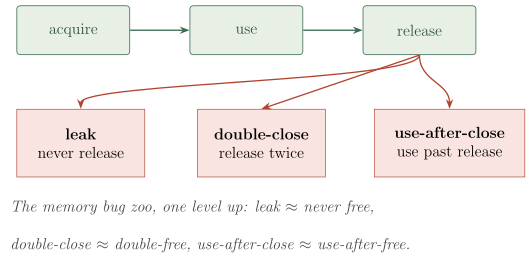
- Leak: acquire, never release (like a memory leak).
- Double-close: release twice (like double-free).
- Use-after-close: use after release (like use-after-free).
Open and close, by hand
A file descriptor is opened and closed explicitly. open_in path
hands you an in_channel; you read from it; you call close_in ic
yourself when you are done. The compiler does not track the
channel's lifetime. It trusts you to do three things: call close
on every path out of the function (including the paths where an
exception is raised), call it exactly once, and never use the
channel after closing it. Miss the first and you leak the
descriptor; break the second and you double-close; break the third
and you read from a closed handle. These are memory's leak,
double-free, and use-after-free again, now for a resource the GC
does not manage.
let ic = open_in "data.txt" in
let line = input_line ic in   (* if this raises, close_in never runs *)
close_in ic                   (* you call this yourself, exactly once *)
Watching the lifecycle
The next example deliberately removes all real file I/O. Its purpose is
to isolate the lifecycle—open, use, close—so each failure is visible
without filenames, operating-system errors, or buffered input getting
in the way. To see these bugs rather than just describe them, we use a
tiny stand-in for a file handle. It prints each step, and raises if you
misuse it, modelling exactly the discipline the real In_channel API
trusts you to keep:
The happy path, written by hand, is easy:
The danger is everywhere off that path. If use h had raised, the
my_close h line would never run, leaking the handle. A second
my_close h prints close and then raises double close. A use h
after my_close h raises use after close. The compiler flags none
of these; the three obligations are entirely on you.
The combinator
OCaml's idiom for resources is higher-order-function scoping:
instead of handing you open and close separately, you wrap the
acquire / use / release in a combinator. The building block is a
function that runs some work, then runs a finally cleanup on
the way out, whether work returns or raises. We can define it
ourselves in three lines, with match ... with exception:
The | x -> arm runs after a normal return; the | exception e ->
arm runs if work () raised, running the cleanup and re-raising.
Either way finally runs exactly once. Now with_handle is a
one-liner: open, hand the handle to f, and let fun_protect
close it on every exit path.
The handle is named only inside f, and my_close runs exactly
once, on both the normal and the exceptional path. (The standard
library ships this same combinator; In_channel.with_open_text
is the file-specific version, opening a channel and closing it on
the way out.)
The payoff: close runs even when the callback raises.
The second call's body raises after use, yet close still prints:
the finally fired on the way out. Because the user never writes
close and never names the handle outside f, all three obligations
are discharged by construction.
You can still leak it
The guarantee is only as strong as the scoping. Nothing stops the
callback from stashing the handle somewhere that outlives the call:
a global ref, say. The combinator still closes the handle on the
way out, as promised, but you are left holding a closed one:
The combinator did its job; the leak came from letting the handle
escape its scope. Runtime scoping cannot prevent this. A stronger
type system, one that tracks whether a value is allowed to escape,
can reject escaped := Some h at compile time. That is the kind of
guarantee a later module builds toward.
Where it breaks down
The escaping handle we just wrote is the simplest case the combinator cannot cover; there are others. The combinator fits only when the resource's lifetime nests inside one function call. Handles that escape: a server accepts a socket and hands it to a worker pool, so the socket must outlive the accept. Complex lifetimes: a buffer shared between two parallel readers, a connection pinned across a multi-call transaction, a lock taken in one function and released in another. None fit "open here, close here."
And the GC is not the answer. OCaml channels do install a finaliser
as a safety net, but finalisers are not prompt (the GC runs on
memory pressure, not file-descriptor pressure, so a program leaking
descriptors but few bytes hits the limit first), run in unspecified
order, and cannot fail meaningfully (a failing close has nowhere
to report). They are a net, not the discipline.
The common case is closed at runtime; the cases it cannot (escaping handles, complex lifetimes, shared buffers) are exactly the ones a later module addresses by lifting this discipline into the type system, so the compiler enforces what the programmer today must remember to wrap.
Activity
A teammate reviewing OCaml code sees this line, where raw_bytes
is a string read from a configuration file on disk:
let parsed : Config.t = Marshal.from_string raw_bytes 0
What is the most accurate critique?
- The type annotation
Config.tis unnecessary. - Version drift can create an invalid
Config.t. Marshal.from_stringis slow; preferMarshal.from_bytes.- The offset
0is wrong.
Why: the issue is version skew. Marshal.from_string returns the
bytes claiming the type the caller wrote. Configuration on disk
crosses a version boundary; if the producer's and consumer's
Config.t differ, the bytes are read at the wrong offsets and the
value crashes on access. A tagged format detects the mismatch
instead. The other options are minor or incorrect.
Which of the following is not part of OCaml's safe fragment?
Array.get, which raisesInvalid_argumentout of bounds.refcells used by a single domain at a time.Obj.magic, which asserts any type for any value.List.map, which traverses a list and produces a new one.
Why: Obj.magic is the canonical escape hatch: it performs no
runtime check and lies to the type system, and a wrong cast crashes
the program. The other three are squarely in the safe fragment:
bounds-checked access, single-domain ref (no race possible), and
pure traversal.
Given fun_protect finally work as defined above, what is
guaranteed about finally?
- It runs only when
workreturns normally. - It runs only when
workraises. - It runs on both return and exception.
- It runs zero times if
workloops forever.
Why: "exactly once, on either exit" is the whole point of
fun_protect. The | x -> arm runs finally and returns the
result; the | exception e -> arm runs finally and re-raises.
(If work never returns, no exit happens, so no cleanup happens,
but that is a different bug.)
Why are the GC and finalisers not the primary defence against
file-descriptor leaks, even though In_channel installs a finaliser?
- Finalisers are a recent addition most code has not adopted.
- GC timing follows memory pressure, not resource pressure.
- Finalisers are unsafe and disabled by default.
- Finalisers only work on values that escape their function.
Why: finalisers are not prompt (GC is triggered by memory, file descriptors are a separate limited resource), run in unspecified order, and cannot fail meaningfully. They are a safety net; the discipline is the combinator.
Implement save_and_restore_ref : 'a ref -> (unit -> 'b) -> 'b that
snapshots r, calls f (), and unconditionally restores the
snapshot to r before returning, whether f returned or raised.
Use the fun_protect combinator from earlier in this lecture.
Show reference solution
A reference solution snapshots the value, then restores it in the
finally:
The snapshot is taken before fun_protect runs the body; on either
exit the cleanup fires and r is restored. No path through the body
forgets to restore. This is the same shape as with_handle:
snapshot, work that may raise, undo on the way out.
What's next
The tutorial closes the module by walking one famous CVE, Heartbleed, end to end: the bug in OpenSSL, the exploit, the one-line fix, and the OCaml equivalent where the same bug class is structurally impossible. It is where the whole safety picture (memory, data races, the honest boundary, resources) lands on one concrete case.
Reading
- OCaml manual, Module
Obj: https://v2.ocaml.org/api/Obj.html - OCaml manual, Module
Marshal: https://v2.ocaml.org/api/Marshal.html - Real World OCaml, Foreign Function Interface: https://dev.realworldocaml.org/foreign-function-interface.html
- OCaml manual, Interfacing C with OCaml: https://v2.ocaml.org/manual/intfc.html
Sources
This lecture's prose, worked examples, and quizzes are original to
this course. The descriptions of Obj.magic, Marshal, the FFI,
and In_channel follow the relevant chapters of the OCaml manual
and Real World OCaml; we summarise the safety-relevant subset. The
fun_protect combinator is our own three-line definition of the
standard resource-cleanup pattern. See
LICENSES.md
at the repository root for the full source posture.