Tutorial: walking Heartbleed end to end
The lectures so far built the safety picture in generality: the categories of memory bugs and why they matter, how OCaml rules them out by construction, data races, and the honest boundary where OCaml itself admits UB. This tutorial lands all of it on one concrete, exhaustively-documented case study: Heartbleed, CVE-2014-0160, the 2014 OpenSSL bug. OpenSSL ran on roughly two-thirds of the web's servers at the time, and the vulnerable releases (1.0.1 through 1.0.1f) exposed an estimated 17 percent of TLS-enabled web servers, around half a million machines (Netcraft, April 2014).
The choice is deliberate: it is the best-documented memory-safety
incident in computing history. The bug is two lines of code, the
exploit is one paragraph, the fix is a single length comparison, and
the OCaml equivalent of the same handler, written with the standard
Bytes API, is structurally incapable of the same bug. The bounds
check is mandatory; the out-of-bounds bytes are never read.
The TLS heartbeat extension
TLS is the protocol behind every HTTPS URL. In 2012 the standards committee added a heartbeat extension (RFC 6520): long-lived TLS connections sometimes go quiet, and middleboxes drop them during the silence, so either side may send a small message asking the peer to echo it back, as a liveness check. A heartbeat request carries a type byte, a two-byte payload length, the payload of that length, and at least 16 bytes of padding; the response echoes the payload. The whole exchange runs inside the existing encrypted channel. The spec is two pages. The trouble was in how it was implemented.
TLS heartbeat (RFC 6520)
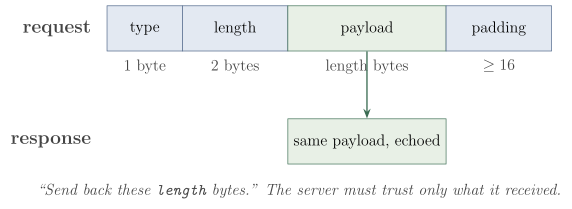
- A liveness check inside an established TLS connection.
- The response echoes the payload back.
The OpenSSL code, abbreviated
OpenSSL implements TLS for most of the internet's HTTPS servers. The 2012 heartbeat handler looked, in essence, like this (simplified; the relevant lines are these):
You do not need to know C pointer syntax to follow it. Read the names
as a four-step recipe: p is the cursor in the incoming request;
payload is a number supplied by the peer; pl remembers where the
actual payload bytes start; and bp is the cursor in the outgoing
response. The helper n2s reads a two-byte number, s2n writes one,
and memcpy(destination, source, count) copies exactly count bytes.
hbtype = *p++;
n2s(p, payload);                            /* read 2-byte length */
pl = p;                                     /* pointer to payload */

unsigned char *buffer = OPENSSL_malloc(1 + 2 + payload + padding);
unsigned char *bp = buffer;
*bp++ = TLS1_HB_RESPONSE;
s2n(payload, bp);                           /* write 2-byte length */
memcpy(bp, pl, payload);                    /* copy payload bytes */
Trace the data flow. The handler reads the two-byte payload length,
allocates a response of that size, and copies payload bytes from
the incoming record into it. The bug is in the memcpy: it uses the
peer-controlled payload value as the copy length without checking
that the incoming record actually contains that many bytes. The
payload field is a 16-bit number chosen by the peer, 0 to 65535;
the record's real size is whatever the peer sent, which can be far
smaller.
If the attacker sends one byte of payload but declares payload = 65535, the memcpy reads 65535 bytes starting at pl: the first
from the legitimate payload, the next 65534 from whatever lives in
memory after the record. That is the server's working memory:
session keys, the certificate's private key, other connections'
data, log buffers. The handler then sends the whole buffer back.
The over-read, drawn out: a tiny real payload, a huge claimed length, and the copy scooping up everything next door.
The over-read, visually
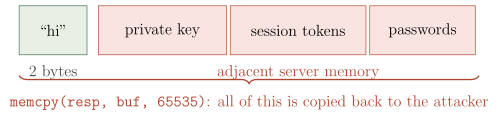
- 2 bytes received, 65535 claimed.
- The copy runs past the payload into keys, tokens, passwords.
The bug is an out-of-bounds read (the read side of buffer overflow), CWE-126. It shipped in OpenSSL 1.0.1 through 1.0.1f, was disclosed on 7 April 2014, and by that evening every public TLS server was running it. Recovery (patching, rotating keys, reissuing certificates) ran for months.
We can build the same over-read
The exploit needs nothing exotic. The miniature C program
heartbleed_mini.c mirrors the structure of the real handler: a
receive_heartbeat function reads a request buffer, interprets it as
a heartbeat (a type byte, a two-byte length, then the payload), and
echoes payload_len bytes back, never checking that the request
actually carried that many:
unsigned char *receive_heartbeat(unsigned char *request, int received,
                                 int *resp_len) {
  unsigned char *server_mem = malloc(64);
  memcpy(server_mem, request, received);              /* the request */
  strcpy((char *)server_mem + 16, "TLS-PRIVATE-KEY"); /* server's secret, nearby */

  int payload_len = n2s(server_mem + 1);   /* attacker-controlled */
  /* THE BUG: payload_len is never checked against `received`. */
  unsigned char *response = malloc(payload_len);
  memcpy(response, server_mem + 3, payload_len); /* reads past the request */
  *resp_len = payload_len;
  return response;
}
The attacker sends a tiny request: a type byte, a length field
claiming 48, and one real payload byte ('h'). The secret is not in
the request; it lives in the server's memory, next to where the
request landed. memcpy copies all 48 claimed bytes: the one real
byte, then whatever sits next to it on the server. response, sent
back to the attacker, now carries the secret. The real bug read up to
64 KB across whatever the allocator had placed nearby; the bytes
after the payload are arbitrary server memory, and here they happen
to spell a secret, but the point is that whatever is adjacent is
transmitted. Run it:
ocaml-vm:~/m10# make heartbleed && ./heartbleed_mini
request carried 1 real payload byte, claimed 48
echoed back: h............TLS-PRIVATE-KEY....................
The exploit, and the fix
The real exploit: open a legitimate TLS connection, send a heartbeat
with payload = 65535 and one real byte, receive ~64 KB of server
memory, repeat. Observed leaks included TLS private keys (with which
an attacker can decrypt captured traffic and impersonate the server),
session tokens, passwords, and log buffers. The attacker did not
choose what they got; they got whatever was adjacent, and over
millions of requests that is a lot.
The official fix (OpenSSL commit 96db9023) was a length comparison:
if (1 + 2 + payload + 16 > s->s3->rrec.length)
    return 0;   /* discard the malformed request */
One line. It checks that the incoming record is at least big enough to hold what the length field claims; if not, the handler refuses. The out-of-bounds read never happens.
This is the part most often misread. "OpenSSL is too complicated"; "the developers should have been more careful." The bug was a missing length check on a hot path in a 250,000-line library that hundreds of contributors had reviewed. In C, every memory access needs a length check, every check is the programmer's responsibility, and any one can be forgotten on any line. The fix is one comparison; preventing the next Heartbleed needs a language that does not let the comparison be omitted.
The OCaml equivalent: bug class impossible
Now the same handler in OCaml, using Bytes (the safe-fragment
equivalent of a C unsigned char *):
We never wrote a length check. We just asked for Bytes.sub record 3 payload_len. So what happens when payload_len = 65535 but the
record is 4 bytes long? The answer is in Bytes.sub's contract: it
raises Invalid_argument if pos and len do not designate a valid
range. The bounds check is part of the API, not optional, not a
performance opt-in, not a thing a programmer can forget. The function
refuses at the call site, before any out-of-bounds byte is touched.
record = "type | 0xff | 0xff | one_byte"   (* only 4 bytes long *)

Bytes.sub record 3 65535
  -> Invalid_argument   (* raised before any byte is read *)
The exception propagates to the handler's caller, which closes the connection. The attacker gets a connection close, not 64 KB of memory. The C code needed a programmer to remember a length check; the OCaml code needs a programmer to opt out of one, and there is no opt-out in the safe fragment.
A refinement: Cstruct and ocaml-tls
The OCaml ecosystem has Cstruct for typed slicing of binary
buffers; Cstruct.sub has the same bounds-check semantics as
Bytes.sub. The production OCaml TLS implementation, ocaml-tls,
uses Cstruct throughout. It has not had Heartbleed-class bugs, and
cannot, because the underlying APIs do not permit them. (A later
module returns to this stack.)
At the FFI boundary
Most OCaml programs that talk TLS either use the pure-OCaml stack or
call OpenSSL through the FFI. The bounds-check safety holds on the
OCaml side; at the FFI boundary it is only as good as the wrapper. A
binding that hands an unchecked length to a C memcpy has the
original Heartbleed bug on the C side. The defence is to slice on the
OCaml side (Bytes.sub, which checks) before the call, so the C
side receives a buffer that is already the right size. This is the
honest-boundary point from the previous lecture, applied to TLS.
Leak bugs vs corruption bugs
Heartbleed is a corruption bug: one request, 64 KB exfiltrated, immediate and detectable per request. Contrast the resource-leak bugs from the previous lecture: a leaked file descriptor exfiltrates nothing, but ten thousand of them over a week of uptime exhaust the limit and the server refuses every new connection. The failure looks like "stopped accepting connections," not "leaking secrets," and arrives through slow accumulation, not one malformed request. Both are safety-relevant; the corruption class is closed by bounds checks, the leak class by the resource combinators.
The big picture
This tutorial is the whole module in one example:
- the bug catalogue: Heartbleed is a buffer over-read, one of the four canonical memory bugs.
- the security cost: it leaked TLS private keys, session tokens, and passwords; the cost to the internet ran to hundreds of millions.
- the safety mechanism: bounds checking, mandatory on every
Bytesaccess, eliminates the bug class structurally. - the honest boundary: this holds in the safe fragment; it would not hold if the handler called into C without preserving the check.
- the resource cousin: leak / double-close / use-after-close, whose defence is the combinator pattern, not the GC.
The module in one sentence:
OCaml's safety is not magic; it is GC + types + exhaustive matching + bounds-checked stdlib, applied consistently.
The pieces are individually unremarkable. The OCaml story is that they are applied consistently: no escape hatch on the hot path, no unchecked-array option for performance. The safety is the floor, not a feature.
Activity
What was the immediate technical cause of the Heartbleed bug?
- The TLS protocol design itself was broken.
- An attacker had to break the encryption first.
- It trusted an unchecked, attacker-supplied payload length.
- OpenSSL was using outdated cryptographic primitives.
Why: Heartbleed is a missing length check. The 16-bit payload
field is attacker-controlled; the handler memcpyd that many bytes
without verifying the request contained them. Sending payload = 65535 with a one-byte request copied ~64 KB of whatever was next in
memory. The cryptography was fine; the bounds check was missing.
Why does the OCaml handler not have the bug, even though it also writes no explicit length check?
- The compiler statically proves
payload_lenfits inrecord. - The GC reclaims out-of-bounds reads before they reach the attacker.
Bytes.subchecks bounds before reading.- OCaml's
Bytesare immutable, so a read cannot exfiltrate.
Why: the property is runtime, not static. OCaml cannot prove the
attacker's payload_len is in range, but Bytes.sub checks at call
time and raises if not. The check is in the contract, with no opt-out;
the exception propagates and the connection closes. Every Bytes
access goes through this same discipline.
Write safe_sub : bytes -> int -> int -> bytes option that returns
Some (Bytes.sub b pos len) when [pos, pos + len) lies entirely
inside b, and None otherwise. It must never raise, even for
negative or past-the-end arguments. Let n = Bytes.length b.
Check pos >= 0, len >= 0, and pos <= n, then compare
len <= n - pos. Avoid adding pos + len: that sum can overflow.
Show reference solution
A reference solution checks the bounds without adding the indices:
The check happens before Bytes.sub, and the caller sees None
instead of catching an exception. The handler can then be exhaustive:
match safe_sub record 3 payload_len with
| None -> close_connection ()
| Some payload -> build_response payload
The malformed-request case is a pattern-match branch the type system forces you to handle, not an exception waiting to be forgotten.
What's next
Module 10 is complete. The next modules pick up the safety story at the type level (extending what the type checker can guarantee on its own) and then apply the whole stack to building real systems in OCaml. Module 10 has established the foundation: types, GC, exhaustive matching, and a bounds-checked standard library, applied consistently.
Reading
- Heartbleed, the canonical writeup: https://heartbleed.com/
- Netcraft, Half a million widely trusted websites vulnerable to Heartbleed bug (April 2014): https://www.netcraft.com/blog/half-a-million-widely-trusted-websites-vulnerable-to-heartbleed-bug
- CVE-2014-0160 in the NVD: https://nvd.nist.gov/vuln/detail/CVE-2014-0160
- OpenSSL fix commit: https://github.com/openssl/openssl/commit/96db9023b881d7cd9f379b0c154650d6c108e9a3
- RFC 6520, the TLS heartbeat extension: https://www.rfc-editor.org/rfc/rfc6520
Cstruct: https://github.com/mirage/ocaml-cstructocaml-tls: https://github.com/mirleft/ocaml-tls
Sources
This lecture's prose, code examples, C demo, and exercises are
original to this course. The OpenSSL code excerpt is reproduced for
educational purposes from the public OpenSSL source tree under the
fair-use exemption for critical commentary and teaching. The
Heartbleed writeup, the Netcraft survey, the NVD CVE entry, and the
OpenSSL fix commit are public documents; the Bytes.sub contract is from the OCaml manual.
See
LICENSES.md
at the repository root for the full source posture.