Memory safety by construction
The previous lecture catalogued the four canonical memory-safety bugs in C (use-after-free, buffer overflow, uninitialised read, double-free) and why they dominate real-world CVEs. This lecture makes the OCaml side precise. For each of the four bugs, we identify which language feature rules it out, where in the runtime the rule is enforced, and what the cost is. Then we sketch the runtime infrastructure that makes these rules implementable: tagged pointers, block headers, and what the garbage collector actually does.
The point of this lecture is not "OCaml is safe, trust us." The point is "OCaml is safe, here is the mechanism, the mechanism is small enough to fit in one lecture, and you can run it in your browser."
We close with the honest boundary: this story holds for the safe
fragment. Outside it (Obj.magic, FFI, Marshal with the wrong
type, races across domains) the guarantees weaken, which a later
lecture in this module walks in detail.
Use-after-free: ruled out by the GC
The C use-after-free pattern was: a program calls free on a
block, then later reads or writes through a pointer that still holds
the address of that block. The bug is temporal: the address is
"valid" in the sense that it is a real address; it just no longer
belongs to the program.
In OCaml the bug class is impossible because the bug cannot be written down. Two things rule it out, working together.
No free primitive. OCaml's surface language has no free, no
delete, no dispose. The programmer never tells the runtime "this
block is now garbage." This is the same design choice as Java, C#,
Python, Go, and Haskell; in OCaml's case it has been the design
since the language's first release in 1996.
Garbage collection. Memory is reclaimed automatically, but only after every reference to the block has gone out of scope. The GC walks the roots (the stack, the registers, global variables) and follows every pointer; any block that remains unreachable after that walk is dead and can be reclaimed. By the time the GC reclaims a block, no part of the program is holding a pointer to it.
These two together close the bug class structurally. If you cannot free explicitly, you cannot free early. If the GC only frees blocks nothing references, "after free" has no observable moment: there is no time at which a live pointer refers to freed memory.
There is a subtlety worth naming, because it comes up in discussions with C programmers. The GC reclaims based on reachability, not liveness. A pointer can remain reachable long after the program will never use it again; the GC will not collect the block until the pointer itself becomes unreachable. This is a space leak: the program uses more memory than it needs. The term is deliberately distinct from C's memory leak. In C, leaked memory has become unreachable without being freed, and can never be reclaimed; the GC rules that failure out entirely. In a space leak the memory is still reachable, and is reclaimed the moment the last reference is dropped. A space leak is a performance bug, not a memory-safety bug. It cannot become an arbitrary-code-execution exploit, because the language still cannot read freed memory; it can only retain too much memory for too long.
A tuple makes the gap concrete. Bind a pair of two lists, then use only the first component from then on:
The program never touches the second list again, so it is not
live. But it stays reachable through pair for as long as
pair is in scope, so the GC keeps it. A collector that knew the
future could free it; a reachability-based collector cannot tell.
Reachability over-approximates liveness, and the gap between the two
is exactly where space leaks live.
"OCaml has no use-after-free" does not mean "OCaml has perfect memory hygiene." It means the specific UB pattern of UAF, and the security consequences that follow from it, are eliminated.
Buffer overflow: ruled out by bounds checking
The C buffer-overflow pattern was: a program writes or reads beyond the end of an allocated buffer. The write may corrupt adjacent memory; the read may leak adjacent memory (the Heartbleed case). The bug is spatial: the address is wrong by some number of bytes.
OCaml rules this class out by making every access to an indexed
structure go through a bounds check. The standard-library functions
Array.get, Array.set, String.get, Bytes.get, Bytes.set
all take an index, compare it against the structure's length, and
raise Invalid_argument if the index is out of range. There is no
unchecked alternative in the safe fragment. The indexing syntax
a.(i), s.[i], and b.{i} all desugar to these checked
accessors.
Let us see the check fire. The cell below indexes past the end of a
three-element array; the runtime raises Invalid_argument at the
offending access, and control transfers immediately to the nearest
handler, or to the top level. The out-of-bounds memory is never
touched. Change the 99 to 1 and re-run to see the in-range
access go through; change it to -1 to see the check catch the
other side. There is no Heartbleed-shaped leak because there is no
point in time at which the runtime is willing to read bytes outside
the allocated region.
The bounds-checking cost is a comparison and a branch on each access. The expectation might be that this dominates; in practice it does not. Modern CPUs predict in-bounds branches with near-perfect accuracy (the cost is around half a cycle in steady state), and the compiler can sometimes eliminate the check entirely when it can prove the index is in range. The remaining cost is a small percentage in most workloads. It is also exactly what the previous lecture's exploit walk-through was prevented from doing: the bounds check is the moment Heartbleed would have died.
Uninitialised read: ruled out by binding-time initialisation
The C uninitialised-read pattern was: a program declares a variable, reads it before assigning, and gets whatever bytes were left over. In the kernel cases, the leftover bytes were sometimes sensitive, and the bug became a security incident.
OCaml rules this class out by requiring an initial value at binding
time. There is no equivalent of int x;. Every let x = ...
requires the right-hand side to evaluate to a value. There is no
syntactic shape that introduces a name without giving it a value.
For mutable storage the same rule applies: ref requires an initial
contents, and Array.make n x requires the fill value x. There is
no Array.uninitialised n in the safe library.
The closest analogue is ref None, which holds the well-typed value
None : 'a option; reading it returns None, which the type system
forces the programmer to handle. There is no path from ref None to
leaking a secret.
Double-free: ruled out trivially
This one is the easiest. C's double-free requires the program to
call free twice on the same block. OCaml has no free. There is
no free to call once, let alone twice. The bug class is closed
because the operation does not exist. The same observation makes the
entire family of manual-memory hazards (use-after-free, double-free,
forgotten-free, freeing a pointer that was never allocated)
disappear: the GC owns deallocation, and the programmer cannot
participate in it.
Sketch of the runtime
The four "by-construction" arguments rely on the runtime to do real work. Let us spend a few minutes on what is actually happening, because the promise about the missing 63rd bit from the literals lecture pays off here.
Tagged pointers
The runtime represents every value uniformly as a single machine
word. Some words are immediate values (small integers, booleans,
()); others are pointers to heap-allocated blocks. The runtime
must tell these apart at every step: the GC has to know which words
to follow, and primitives have to know how to interpret each
operand.
The trick is to use the low bit of every word as a tag: immediates
set it to 1, pointers to 0. Heap blocks are always allocated at
word-aligned addresses, so a pointer's low bit is naturally zero,
free to use as a tag. One bit test distinguishes an immediate from a
pointer. This is the choice that cost us the 63rd bit of integer
range; the benefit is a uniform representation, a simple GC, and the
categorical absence of the "is this word a pointer?" ambiguity that
makes C-level memory analysis so painful.
The 63-bit figure is a fact about the native compiler on 64-bit
hardware, not about the language. On 32-bit native targets the same
trick gives a 31-bit int: one word, one tag bit. And a backend
that does not need the trick can decline it: js_of_ocaml, the
compiler that turns OCaml into JavaScript (and the one running the
cells on this very page), represents int as a plain 32-bit
JavaScript integer with no tag bit at all, because JavaScript
values already carry their own type information. The runtime will
tell you which world you are in:
Run it here and both answers are 32: no bit lost to a tag. Compile the same two lines natively on a 64-bit machine and they are 64 and 63: the missing bit is the tag.
Tagged values
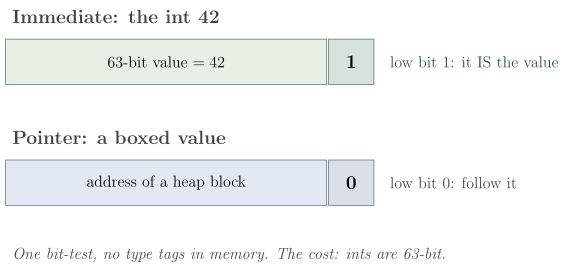
- Low bit
1= immediate;0= pointer. One bit-test tells them apart. - Cost: 63-bit
int; benefit: a simple, uniform GC.
Block headers
Every heap-allocated block has a small header word in front of it,
encoding the block's size (how many words follow), its tag (what
kind of content: tuple-like, string-like, closure, ...), and the GC
colour used during a sweep. The header is invisible to the surface
programmer. It is also the answer to "how does Array.length know
the length?": the size is in the header, so every block carries its
size with no extra per-array word.
Block headers
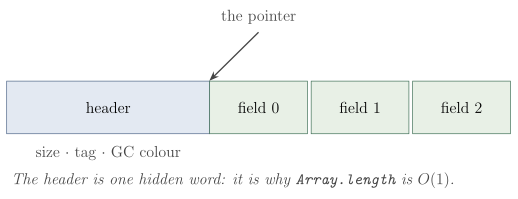
- One header word per block: size, tag (kind), GC colour.
- Invisible to the surface programmer.
- This is why
Array.lengthand bounds checks are O(1) with no extra storage.
What the GC does
The GC's job is to find and reclaim memory the program will not use again. OCaml's GC is generational: it bets that most allocations die young. New blocks go in a small minor heap (fast bump-pointer allocation), collected often and cheaply; survivors are promoted to a major heap, collected less often by mark-sweep-compact. The conceptual model:
- Allocate: bump a pointer in the minor heap, write the header, return the address.
- Minor heap fills: walk roots, copy anything still reachable into the major heap, reclaim the rest of the minor heap wholesale.
- Major heap accumulates: periodically mark every reachable block from the roots and reclaim the unmarked ones; compaction may defragment.
Reachability is central. A block is reachable if a root points at it, or a reachable block points at it. The GC reclaims only unreachable blocks, and no reachable block points at an unreachable one, so at the moment a block is reclaimed nothing in the program points at it. The C use-after-free pattern has no representation in this model.
The GC, in one paragraph
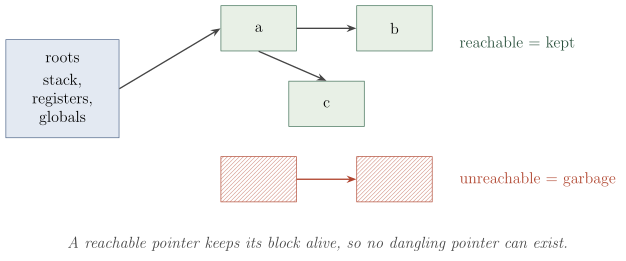
- Walk the roots; anything reachable is live, the rest is garbage.
- Garbage is reclaimed only when unreachable.
- so no live pointer ever refers to freed memory.
Why the GC can move blocks
Tagged words and block headers together explain a superpower of
OCaml's GC: it can move blocks, to compact the heap or to promote
survivors out of the minor heap. Moving a block means rewriting
every pointer to it, and the runtime can do that only because the
tag bit lets it enumerate exactly which words are pointers. One more
property is needed, and OCaml has it by construction: there are no
interior pointers. An OCaml pointer always points at the first
field of a block, never into the middle of an object. So every
pointer determines exactly one block (its header sits one word
before the address), and after the block moves there is exactly one
correct new value to write. C has neither property: a word holding a
long is indistinguishable from one holding a void *, and
pointers into the middle of arrays and structs are everywhere, so a
C runtime can never relocate an object.
Why the GC can move blocks
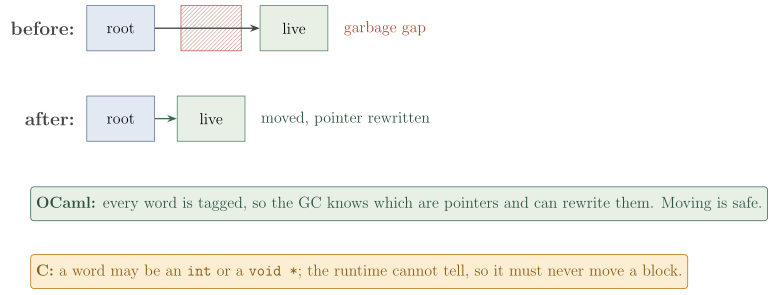
- Moving a block means rewriting every pointer to it.
- No interior pointers: every pointer targets a block's start.
- the header is one word before; the new value is unique.
The total runtime overhead of the GC is typically a few percent of CPU time in long-running workloads; the bounds-check overhead is smaller. Together the safety overhead is a small fraction of the program's runtime, and in exchange the four bug classes are eliminated.
A small exercise
Write a function safe_nth : 'a list -> int -> 'a option that
returns Some x if position n is in range, and None otherwise.
The function should never raise an exception, even on negative
indices or indices past the end. Hint: walk the list, decrementing
the index; return None if the list runs out or the index is
negative.
Show reference solution
A reference solution walks the list, decrementing the index, and
returns None on the empty list or a negative index.
This is the OCaml-flavoured version of bounds-checked indexing.
List.nth raises Failure out of bounds; if you want a non-raising
version you write one. Either way the out-of-bounds bytes are never
read; the only question is whether the boundary is reported as an
exception or as None.
A C program calls free(p), and then a few microseconds later
another part of the program reads *p. What does the OCaml analogue
look like?
- The OCaml program also reads stale bytes, but the GC catches it later.
- Safe OCaml has no
free; reachable blocks stay live. - The OCaml program raises a runtime exception "use after free".
- The OCaml program's behaviour is implementation-defined.
Why: OCaml has no explicit free. The GC reclaims a block only
after it becomes unreachable. The "free, then later access the freed
pointer" pattern requires a live reference to exist after the
free, which contradicts the GC's reclamation rule. The pattern is
not implementable in safe OCaml, and there is no "use after free"
exception because there is no moment at which a live reference points
at a freed block.
Why does the OCaml runtime use the low bit of every value as a tag, even though it costs one bit of integer range?
- To accelerate integer arithmetic on x86.
- To distinguish signed from unsigned integers at runtime.
- To distinguish pointers from immediate values.
- Backwards compatibility with 32-bit machines.
Why: OCaml represents every value uniformly as a single word.
The GC must walk every reachable word and decide whether to follow
it as a pointer; primitives must decide whether an operand is a heap
address or a boxed value. The low-bit tag (1 for immediates, 0
for pointers, heap allocations always aligned) means one bit test
suffices. The cost is a 63-bit int; the benefit is a uniform,
simple GC.
The honest boundary
The four arguments hold for the safe fragment: the surface
language and its standard library, excluding Obj, Marshal with
the wrong type, and FFI. Step outside and the guarantees weaken. The
unsafe operations are deliberately named (Obj.magic has "magic" in
the name; Marshal.from_string takes a type the runtime does not
check; FFI requires the keyword external), so a code review can
ban them outside specifically-audited modules. A later lecture in
this module walks that boundary in detail.
What's next
The next lecture turns to a UB category we have so far only named: data races, the bugs that appear when a program runs on more than one core at once. Then a lecture on where OCaml itself has UB (the escape hatches, and resource safety beyond memory), and finally the tutorial that walks one real CVE end to end and shows the same bug is structurally impossible in OCaml.
Reading
- Cornell CS3110, References and memory locations: https://cs3110.github.io/textbook/chapters/mut/refs.html
- Real World OCaml, Memory representation of values: https://dev.realworldocaml.org/runtime-memory-layout.html
- OCaml manual, The garbage collector: https://v2.ocaml.org/manual/intfc.html
Sources
This lecture's prose, worked examples, and quizzes are original to
this course. The runtime sketch (tagged pointers, block headers, GC)
is the standard exposition that appears in the OCaml manual, Cornell
CS3110, and Real World OCaml; we present the conceptual minimum the
rest of the module relies on. See
LICENSES.md
at the repository root for the full source posture.